
A3 Edible Food Printer Meets Operational Realities for Scalable Cake and Cookie Production
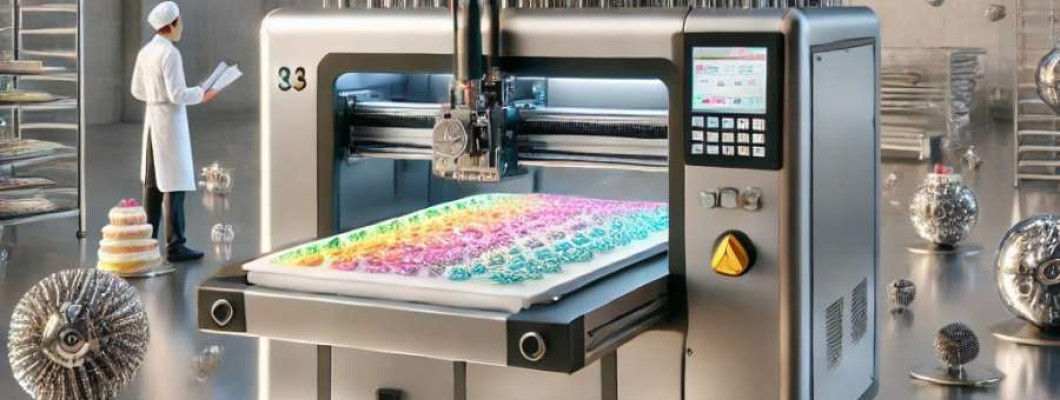
The Industrial Reality of Integrating Edible Printing in High-Volume Baking Facilities
In commercial bakery environments aiming to diversify product lines with edible printing, the transition from standard cake and cookie decoration to automated print-based customization introduces critical operational variables. The A3 Edible Food Printer designed for cakes and cookies addresses the need for high-resolution food-safe ink deposition on delicate substrates, yet this integration surfaces challenges around throughput balancing, ink maintenance protocols, and substrate handling mechanics at scale.
Consider a mid-sized bakery moving from manual icing techniques to printer-based cake toppers intended for rapid fulfillment in multiple retail outlets. This printer must handle varying cake surface curvatures and cookie textures while maintaining micron-level precision and color fidelity. The operator's workflow shifts from artisanal craft to monitoring machine uptime, ink consistency, and substrate feeding reliability. Furthermore, consumable management—specifically edible ink lifecycle and printhead clogging risks—becomes a continuous concern demanding stringent preventive maintenance and accurate process scheduling. These production realities necessitate a deep understanding of how the printer’s hardware and consumable systems withstand prolonged operation without quality degradation.
Technical Deep-Dive on Printer Mechanics and Operational Metrics
Printhead Technology and Ink Jet Dynamics
The A3 Edible Food Printer utilizes piezoelectric inkjet technology optimized for food-safe dye formulations. Printing resolution peaks at 1200 dpi, translating to a dot size near 10 pl per drop. This enables fine gradations essential for photorealistic edible images on frostings and fondant. However, the physics of ink viscosity (approximately 10-15 cP) combined with rapid jet actuation demands precise thermal regulation within printheads to prevent nozzle clogging—a primary failure mode observed in prolonged runs. Maintaining nozzle temperature within 40°C reduces ink crystallization, enhancing uptime.
Substrate Handling and Print Accuracy
The mechanical design ensures a print platen accommodating sheets up to A3 (297 mm x 420 mm), optimized for uniform substrate thickness up to 10 mm. A vacuum-assisted feeding mechanism secures flexible edible sheets and thin cake icing surfaces without distortion. The X-Y drive employs stepper motors with microstepping control, delivering positional accuracy of 0.01 mm. This precision is critical to avoid color bleeding or image misregistration, especially on textured or uneven cookie surfaces.
Operational Throughput and Cycle Time Computations
Cycle time per print averages 90 seconds for full-color A3 edible prints at maximum resolution. Daily operational throughput therefore maxes at approximately 320 prints over an 8-hour shift, assuming continuous operation and no downtime. Factoring in routine maintenance intervals—typically 30-minute cleaning cycles every 4 hours—realistic throughput reduces to roughly 280 prints per shift. Calculations show that scalability to high volume requires multiple printer units or automated substrate loading/unloading solutions to prevent bottlenecks.
Consumables Lifespan and Maintenance Scheduling
Edible ink cartridges provide approximately 500 ml per color, covering an estimated 450 prints per cartridge at full coverage. The colorant chemistry includes natural food dyes vulnerable to oxidation, necessitating storage below 15°C. Printhead maintenance frequency depends largely on ink type and environmental humidity, with nozzle cleaning recommended every 300 prints to avoid clogs that reduce droplet precision. Scheduled maintenance, including printhead inspection and fluid line purging, reduces unexpected downtimes but adds to operational labor demands.
Comparative Table of Operational Parameters Versus Traditional Manual Decoration
| Parameter | Manual Decoration | A3 Edible Food Printer |
|---|---|---|
| Precision (Resolution) | Variable, approx. 500 dpi equivalent | Up to 1200 dpi at 10 pl droplet size |
| Throughput (Prints/8h) | ~150 due to manual labor limits | ~280 with scheduled maintenance |
| Labor Intensity | High, skilled artisans | Moderate, operator supervision |
| Material Waste | High due to errors and retries | Low due to digital accuracy |
| Maintenance Downtime | Low but unpredictable | Scheduled 30 min every 4 h |
Scenario Analysis of Diverse Business Applications
Scenario 1: Boutique Cake Studio
The precision and color fidelity of the A3 Edible Food Printer enable small batch hyper-customized cake production. Although throughput demands are moderate, the ability to produce micron-level detail and consistent high-resolution images without artisan fatigue represents a transformational upgrade, maintaining product premiumization.
Scenario 2: Large-Scale Cookie Factory
Here, sustained high throughput is paramount. The printer’s robust substrate handling supports cookie sheets up to A3, allowing for simultaneous multiple cookie images per print cycle. Integration challenges emerge in automating loading/unloading, but operational consistency and reliable ink delivery reduce labor overhead and waste substantially.
Scenario 3: Event Confectionary Service
Rapid turnaround and diverse print jobs require flexible substrate accommodation and fast changeovers. The printer’s modular design supports quick ink cartridge swaps and printhead cleaning, minimizing downtime between different event orders while sustaining print quality on a variety of edible materials.
Expert FAQ
Q1: How does substrate moisture variation affect print adhesion?
A1: High moisture levels can disrupt ink polymerization on edible surfaces, causing bleeding and reduced image sharpness. Maintaining substrate humidity below 10% during printing optimizes ink absorption.Q2: What measures prevent cross-contamination in multi-color edible inks?
A2: Separate fluidic channels with one-way valves and dedicated rinsing cycles per color prevent ink mixing within printheads, preserving color purity.Q3: Can the printer handle curved cake surfaces without distortion?
A3: While primarily designed for flat substrates, slight curvature up to 3 mm can be compensated via adjustable platen tensioning, though extreme curves require manual finishing.Q4: What is the energy consumption profile during continuous operation?
A4: The system averages 450 Watts during active printing with peaks during vacuum substrate hold and printhead heating, necessitating thermal management in tightly packed production areas.Q5: How do ambient temperature fluctuations impact edible ink viscosity?
A5: Ink viscosity varies inversely with temperature; above 25°C, viscosity drops, risking droplet scatter, while at lower temperatures viscosity increases risking nozzle clogging. Maintaining ambient temperature between 18-22°C is recommended.
Strategic Verdict and Recommendation
The A3 Edible Food Printer for Printing Cakes Cookies stands as a highly capable industrial-grade solution that navigates the gap between artisanal customization and scalable automated decoration. Its advanced printhead technology, precise substrate handling, and throughput capacity align well with diverse food production environments where micron-level print resolution and consistent color fidelity are non-negotiable.
By explicitly factoring in maintenance cycles, consumable lifespan, and the operational nuances of edible ink chemistry, this printer supports reliable, continuous deployment in bakery settings aiming to scale personalized edible imagery without compromising quality or throughput. For enterprises seeking to integrate automated edible printing with existing workflows, this hardware provides a well-balanced investment with manageable lifecycle costs and clearly defined operational bottlenecks.
Interested professionals should evaluate the printer directly through the A3 Edible Food Printer For Printing Cakes Cookies specification and vendor resources to align technical requirements with production goals.