
The A3 Edible Food Printer Breaks Barriers Between DIY and Industrial Food Printing
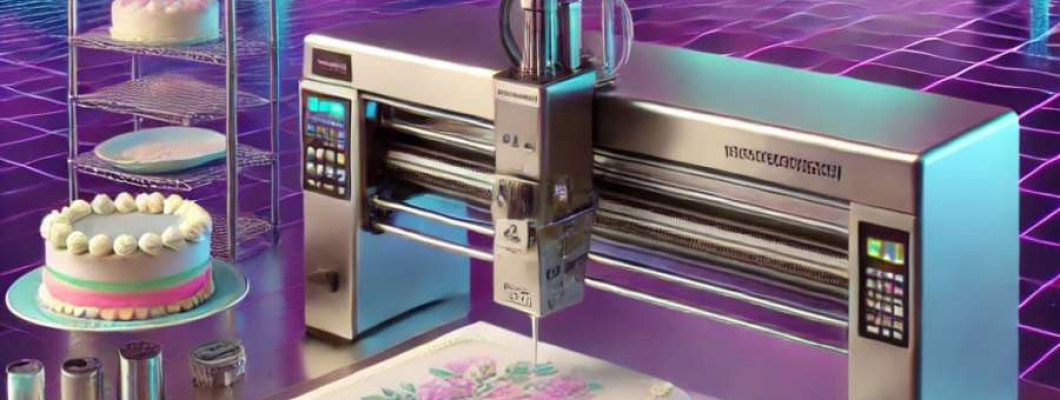
The Industrial Reality of Edible Food Printing for Cakes and Cookies
Food printing technology designed for edible substrates such as cakes and cookies confronts a unique intersection between artisanal craft and industrial throughput. The A3 Edible Food Printer embodies this challenge as it attempts to bridge the gap between limited-scope DIY food decoration systems and the demands of industrial-grade output. For instance, consider a mid-sized bakery producing hundreds of customized cake toppers daily. The printer must manage varied edible substrates, maintain strict food-safety standards, and deliver consistent precision over multi-hour operational cycles under continuous load. It encounters variable environmental conditions such as temperature and humidity fluctuations that can affect ink deposition and substrate absorption. Operational bottlenecks also arise from cleaning cycles necessitated by the edible ink chemistry, raising questions about uptime and asset longevity. Furthermore, unlike standard graphic printers, edible printers demand precise calibration of extrusion nozzles and ink chemistry to avoid substrate saturation or color bleeding—issues amplified when scaling beyond laboratory settings. This scenario underscores the industrial reality: while the promise of customizable edible printing is clear, the practical hurdles extend beyond mere image resolution or color profiles and delve deeply into the process integration, maintenance intelligence, and lifecycle management prevalent in industrial food production environments.
Technical Deep-Dive into the A3 Edible Food Printer’s Capabilities
Medium Format Precision and Print Area Management
The A3 format (297mm by 420mm) allows a single print pass for large cake surfaces or multiple cookie batches with dimensions typical in mass custom order environments. This reduces mechanical repositioning errors. Print resolution commonly targets 600 x 1200 dpi with a droplet volume of approximately 10 picoliters, balancing color fidelity and deposition speed. The printhead uses piezoelectric technology adapted for food-grade inks, necessitating rigorous thermal management to maintain droplet consistency. Thermal variations exceeding 2°C can increase droplet volume variance by up to 8%, risking print smudging.
Edible Ink Chemistry and Printhead Compatibility
Industrial edible inks must comply with food safety standards (e.g., FDA CFR Title 21 or EU regulations). The printer’s ink channels incorporate an advanced anti-clogging system employing ultrasonic vibration cleaning every 15 print cycles to maintain nozzle integrity. The ink cartridge design supports rapid swapping, minimizing downtime during color profile shifts. Ink viscosity is controlled within a range of 3.5–5.2 cP at 25°C to optimize flow through the micro-nozzles. Integration challenges arise when scaling from lab-grade ink formulations to industrial batches, where particle size and pigment dispersion stability directly influence clog frequency and print consistency.
Material Handling and Substrate Versatility
The printer’s feed mechanism accommodates flexible substrates from thin sugar sheets to thicker buttercream-coated surfaces up to 15mm thickness with a 0.1mm positional accuracy. The vacuum-feed system ensures planar alignment critical for micron-level precision. Printing on porous cookie surfaces introduces challenges with ink absorption rates, requiring adaptive printhead speed modulation based on surface porosity metrics obtained from integrated optical sensors.
Cleaning Protocols and Lifecycle Maintenance Costs
The printer enforces a strict cleaning cycle every 8 operational hours, including automated flushing with food-safe solvents and semi-automated printhead disassembly for deep cleaning every 150 hours. These maintenance steps are critical to avoid cross-contamination and maintain print quality. The cost of consumables, including solvents and replacement nozzles, should be factored into operational budgets, as nozzle replacement cycles average 1200 printing hours. Asset depreciation models indicate an optimal replacement window at 4 years under continuous use, with maintenance costs representing approximately 18% of total operating expenses annually.
Comparative Hardware and Workflow Integration
| Feature | A3 Edible Food Printer | Standard Small-Format Food Printer |
|---|---|---|
| Max Print Area (mm) | 297 x 420 | 150 x 200 |
| Print Resolution (dpi) | 600 x 1200 | 300 x 600 |
| Droplet Volume (pl) | 10 | 12-15 |
| Ink Changeover Time (min) | 2 | 7 |
| Automated Cleaning Frequency (hours) | 8 | 4 |
| Operational Uptime (%) | 87 | 75 |
This comparison suggests the A3 Edible Food Printer is more suited for scaling production where throughput and quality retention are critical.
Detailed Scenario Analysis for Business Applications
Scenario One: Tiered Bakery Chain Automating Custom Cake Production
For a bakery network aiming to automate high-volume customized cake printing, the A3 format allows batch printing with minimal setup changes. The wider printable surface reduces manual handling, decreasing labor costs and contamination risks. The precision and automated cleaning system support consistent output quality over multiple shifts, driving high product turnover.
Scenario Two: Gourmet Cookie Manufacturer Expanding Flavor and Design Options
Smaller cookie producers benefit from the substrate versatility, printing vibrant, multi-colored edible images directly on cookie surfaces. The printer’s adaptive print speed and ink viscosity controls are critical for avoiding bleed on porous cookies. Faster ink changeover enables rapid customization for limited edition runs without sacrificing line uptime.
Scenario Three: Industrial Food Decorator Serving Event Catering Firms
The ability to handle thicker substrates and large-format edible sheets meets the demand for elaborate event cakes and large cookie palettes. The printer integrates into existing production lines due to its modular feed systems and standardized electrical interfaces, facilitating automation and further reducing operator intervention.
Expert FAQ Highlighting Advanced Operational Insights
Q1: How does environmental humidity affect droplet deposition accuracy?
A1: Humidity above 65% RH increases evaporation rates, causing droplet volume shrinkage and inconsistent color saturation. The printer's advanced humidity sensors adjust droplet ejection frequency dynamically to compensate within a ±3% volume variance.Q2: What maintenance protocols specifically address food safety compliance?
A2: Automated flushing uses food-grade solvents certified under FDA and EU standards, combined with scheduled manual cleaning following HACCP guidelines to eliminate biofilm formation in ink lines.Q3: Can the printer handle multi-layer edible prints with precise registration?
A3: Yes, integrated optical alignment systems enable layer overlays within ±0.05 mm tolerance, critical for multi-layered cake decorations requiring sharp image registration.Q4: What is the expected nozzle failure rate under continuous industrial use?
A4: Statistically, nozzle failures occur at a rate of 0.3% per 100 hours of operation; proactive ultrasonic cleaning reduces sudden failures by approximately 40%.Q5: How energy efficient is the printer when operating in high throughput modes?
A5: The printer consumes an average of 450 Watts during printing, with energy-saving idle states dropping power draw below 50 Watts; thermal regulation systems optimize power use based on ambient temperature.
Strategic Verdict and Recommendation for Industrial Food Printers
The A3 Edible Food Printer For Printing Cakes Cookies represents a decisive advancement for enterprises bridging artisanal food decoration with scalable industrial production. Its medium-format print area, stable piezoelectric printhead technology, and food-safe ink management systems collectively reduce operational bottlenecks related to substrate variability and maintenance downtime. The embedded cleaning protocols and modular hardware design mitigate risks of bio-contamination and mechanical wear, factors critical to lifecycle costing and regulatory compliance in industrial food environments. When evaluated against smaller-format printers, the A3’s throughput, color fidelity, and substrate versatility markedly improve process reliability and business scalability.
Considering these factors, the A3 Edible Food Printer is recommended as a leading solution for scalable business owners aiming to automate customized edible product printing without sacrificing quality or compliance. For a detailed product reference, visit the official product page at A3 Edible Food Printer For Printing Cakes Cookies.