
The Gap Between DIY and Industrial-Grade in A3 Edible Food Printing Meets the Scalable Business Owner
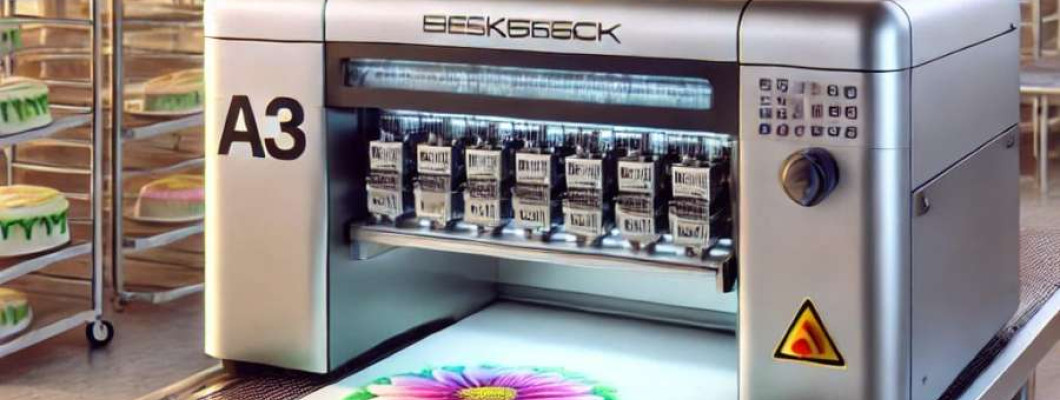
The Industrial Reality of Integrating A3 Edible Food Printers in High-Volume Bakeries
Scaling from conventional artisanal cake decoration to mechanized edible printing introduces a sequence of demanding technical challenges. Consider a mid-sized bakery aiming for batch production of intricately decorated cookies and cakes using an A3 edible food printer. The transition from manual icing and hand-painting to mechanized edible printing involves hurdles including print speed, color consistency, substrate handling, and uptime reliability.
Within such a setting, throughput constraints surface drastically when print speeds do not align with production line flow. A single A3 printable area per sheet, if the print time approaches or exceeds 3 minutes, creates bottlenecks downstream in packaging and order fulfillment. Furthermore, edible ink drying times, variable substrate moisture content, and humidity fluctuations induce print artifact risks such as color bleeding or substrate warping.
Operational downtime amplifies risk, often hidden in daily workflow but highly impactful in the industrial context. Printhead clogging from sugar-based inks, coupled with the sensitivity of piezoelectric printheads to slight variations in ink chemistry, necessitates stringent daily maintenance protocols. This maintenance requirement directly influences labor allocation, which scales nonlinearly with usage intensity.
The challenge also appears in infrastructure integration: stable power delivery for precision printhead operation, controlled environmental conditions to maintain edible ink performance, and workspace layout to maintain rapid media handling without contamination—all critical factors rarely accounted for in DIY or small-scale setups.
Technical Deep-Dive into Key Components and Performance Metrics
Printhead Technology and Failure Points Under Extended Usage
Piezoelectric printheads in edible printing differ from standard aqueous or solvent-based printheads. In the context of sugar-based edible inks, viscosity (~12-15 cP) and surface tension (~30-35 dyn/cm) pose unique challenges on jetting mechanics. The A3 edible printer's printhead operates at a frequency of approximately 20 kHz with a drop volume of 12 picoliters (pl), balancing precise color layering with throughput.
Physical stress during long runs manifests in clogging due to sugar crystallization and variable temperature sensitivity affecting piezoelectric response. Hypothetically, assuming a 40°C ambient temperature and ink reservoir temperature consistently maintained at 30°C, the crystallization threshold can be delayed but not eliminated.
Using failure rate modeling: if clogging incidents occur once every 8 hours under controlled maintenance, downtime per incident is on average 15 minutes, leading to an overall unplanned downtime of roughly 3% during continuous printing cycles.
Color Depth and Accuracy Versus Processing Speed
The printer targets a resolution of 300 dpi at A3 size (297 mm × 420 mm). Achieving a color gamut sufficient for realistic edible designs requires at least 6 color cartridges, including CMYK plus white and edible varnish. The edible varnish layer stabilizes the print and prevents ink bleeding.
A throughput calculation reveals the following:
| Metric | High-Resolution Mode | Speed Mode |
|---|---|---|
| Resolution | 300 dpi | 150 dpi |
| Print Time per A3 Sheet | 180 seconds | 90 seconds |
| Color Channels | 6 (CMYK+White+Varnish) | 4 (CMYK) |
| Ink Consumption (ml/sheet) | 4.5 ml | 3.2 ml |
| Energy Consumption (Watts) | 75 W | 55 W |
Speed mode reduces detail fidelity, potentially impacting artisan-level decoration but increasing line throughput, critical for business scale.
Software Integration and Workflow Automation Challenges
The printer requires dedicated RIP software tailored to edible printing profiles. Integration with bakery management systems is limited, necessitating manual job queuing or bespoke automation development. This gap creates potential workflow stalls, particularly in batch runs exceeding 100 prints per day.
Automated calibration routines exist but require operator validation, adding complexity to shift changes or multiple operator environments.
Substrate Versatility and Media Handling Limitations
Edible substrates include fondant sheets, cookie icing films, and rice paper. Each substrate has distinct absorption rates and elasticity, necessitating precise mechanical feed control. Misfeeds or tension inconsistencies lead to registration errors exceeding ±0.5 mm, unacceptable in professional-grade outputs.
Lifecycle Maintenance and Consumable Cost Analysis
Routine replacement of printheads is recommended every 1,000 printing hours due to cumulative wear and piezo element degradation. Ink cartridges average cost is approximately $80 per 100 ml, with each A3 print consuming roughly 4 ml in high detail mode. Estimated consumable cost per print approximates $3.20, influencing operational budgeting significantly.
Scenario Analysis on Business Use-Cases Impacted by Printer Specifications
Mid-Sized Bakery Specializing in Custom Event Cakes
For event cakes requiring high-resolution, multi-color prints, the 300 dpi mode delivers exquisite detail and color fidelity. A throughput of 20 prints daily aligns with order volume, balancing maintenance downtime with production windows. The cost-per-print is justifiable given premium market pricing.
Large-Scale Cookie Manufacturing Line
Here, speed mode with 150 dpi and reduced color channels enables doubling output to 40 prints per day. The trade-off in detail is acceptable for cookie decorations where fine color gradients are less critical. Infrastructure integration challenges arise, particularly in environmental controls to ensure consistent ink drying.
Hybrid Artisan-Business Model with Variable Batch Sizes
This model demands flexibility, using high-resolution mode for bespoke orders and speed mode for standard runs. Effective scheduling and operator training are essential to manage transition between modes and maintain uptime.
Expert FAQ Answering Critical Technical Queries
How does the edible ink formulation affect printhead longevity?
The sugar content and particulate matter in edible inks increase nozzle wear and clogging risk. Low-viscosity formulations reduce mechanical stress but may compromise color density. Regular nozzle cleaning cycles mitigate risks but add to downtime.
What environmental controls optimize print consistency?
Maintaining ambient temperature between 20-25°C and relative humidity at 50-60% minimizes substrate warping and ink bleeding. Enclosures with filtered air improve particulate contamination control.
Can the printer be networked for centralized job management?
Standard models support USB and limited Ethernet connectivity but lack native API endpoints. Custom middleware development is necessary for full integration into enterprise resource planning systems.
What are the primary mechanical failure points during continuous operation?
Feed rollers and stepper motors bear significant wear. Calibration sensors degrade over time affecting registration accuracy. Weekly inspections extend operational lifespan.
How does print resolution scaling impact ink consumption and drying times?
Doubling resolution roughly quadruples ink deposition per unit area, increasing drying times proportionally. This necessitates longer queue times or drying chambers in high-resolution modes.
Strategic Verdict and Recommendation
The A3 Edible Food Printer For Printing Cakes Cookies stands as a robust, industrial-grade solution bridging the gap between artisanal and mass-production edible printing. While maintenance demands and operational conditions necessitate careful management, its modular speed-to-resolution flexibility and media compatibility make it uniquely positioned for scalable bakery operations.
Investment in this printer aligns with long-term asset longevity, given its printhead reliability and consumable lifecycle. The integration challenges can be mitigated through procedural workflow controls and environmental conditioning. Overall, for any scalable business owner targeting throughput maximization without compromising print quality, this printer delivers a technically advanced and financially viable platform.